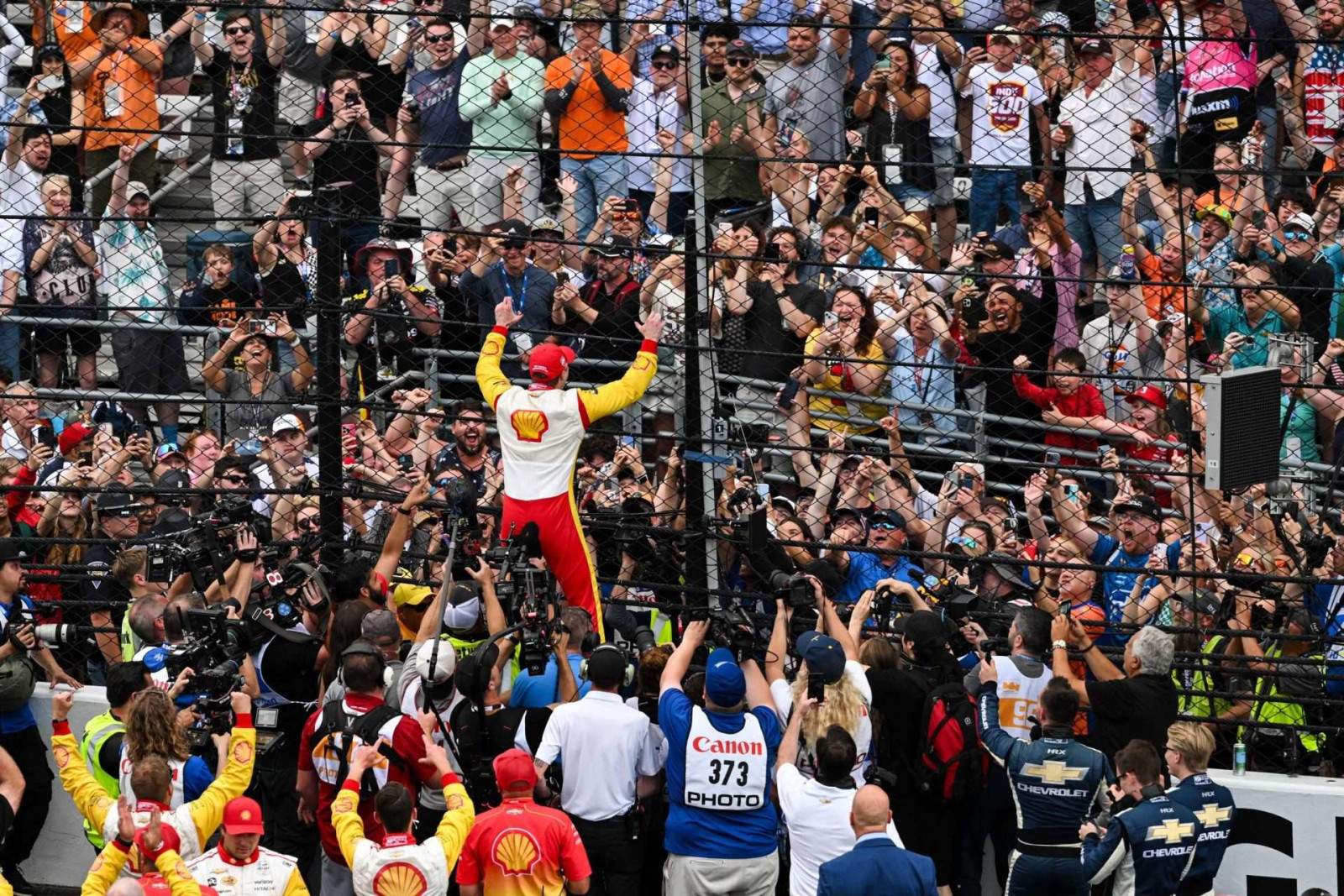
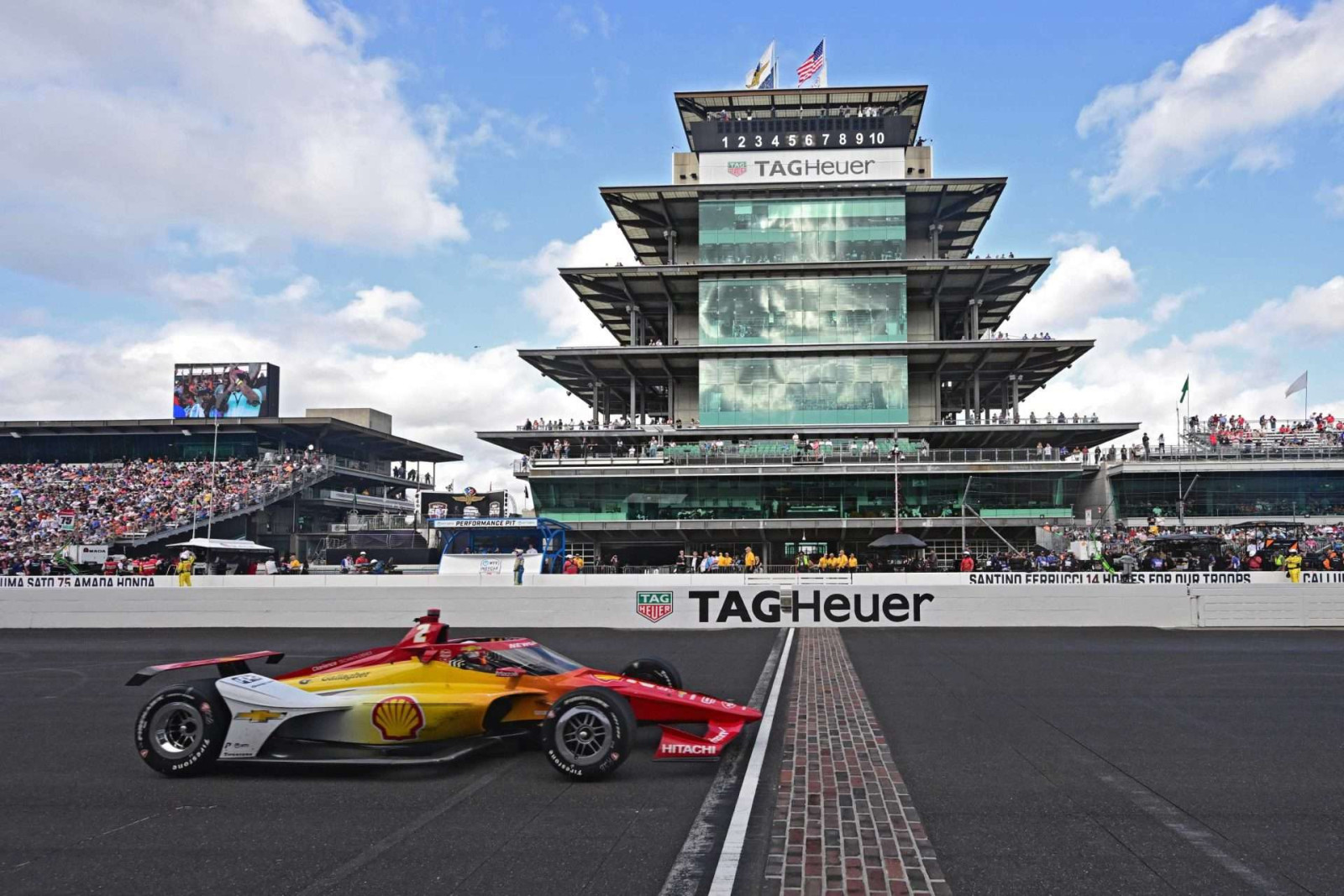
INDIANAPOLIS, IN – To the delight of over 350,000 fans, the 108th running of the Indianapolis 500 finally got underway after a four-hour rain delay. It was a nail bitter as Josef Newgarden exchanged the lead with Pato O’Ward in the final seven laps to earn his second consecutive win and gave team owner, Roger Penske, his 20th Indianapolis 500 victory.
“I knew we could win this race again”, said Newgarden, who also won the 107th running at Indy with a last lap pass following a controversial late Red Flag at the expense of Marcus Ericsson, the 106th winner. “It’s just a matter of doing it right. JD (Jonathan Diuguid, interim strategist) came over the radio and said, ‘You’re going to have to win this the old fashion way; I can’t help you. There aren’t going to be any more stops for fuel.’ So, I just went for it. The car was good enough.”
“I have to give it up to Pato (O’Ward) who could have easily won this race. That final Turn 3 pass – you don’t know if it will work unless you are racing someone like Pato who raced me clean. My team crushed it. We left it all on the track; put it all on the line. You can’t win this race without a great car. The team earned this win with all their hard work the entire month and year. We showed it in qualifying and the race. Our car was so fast.”

Pato O’Ward swapped the lead with his teammate, Alexander Rossi, and also with Newgarden, eight times to lead a total of twelve laps, but not the ultimate one. The margin of victory was 0.3417 seconds.

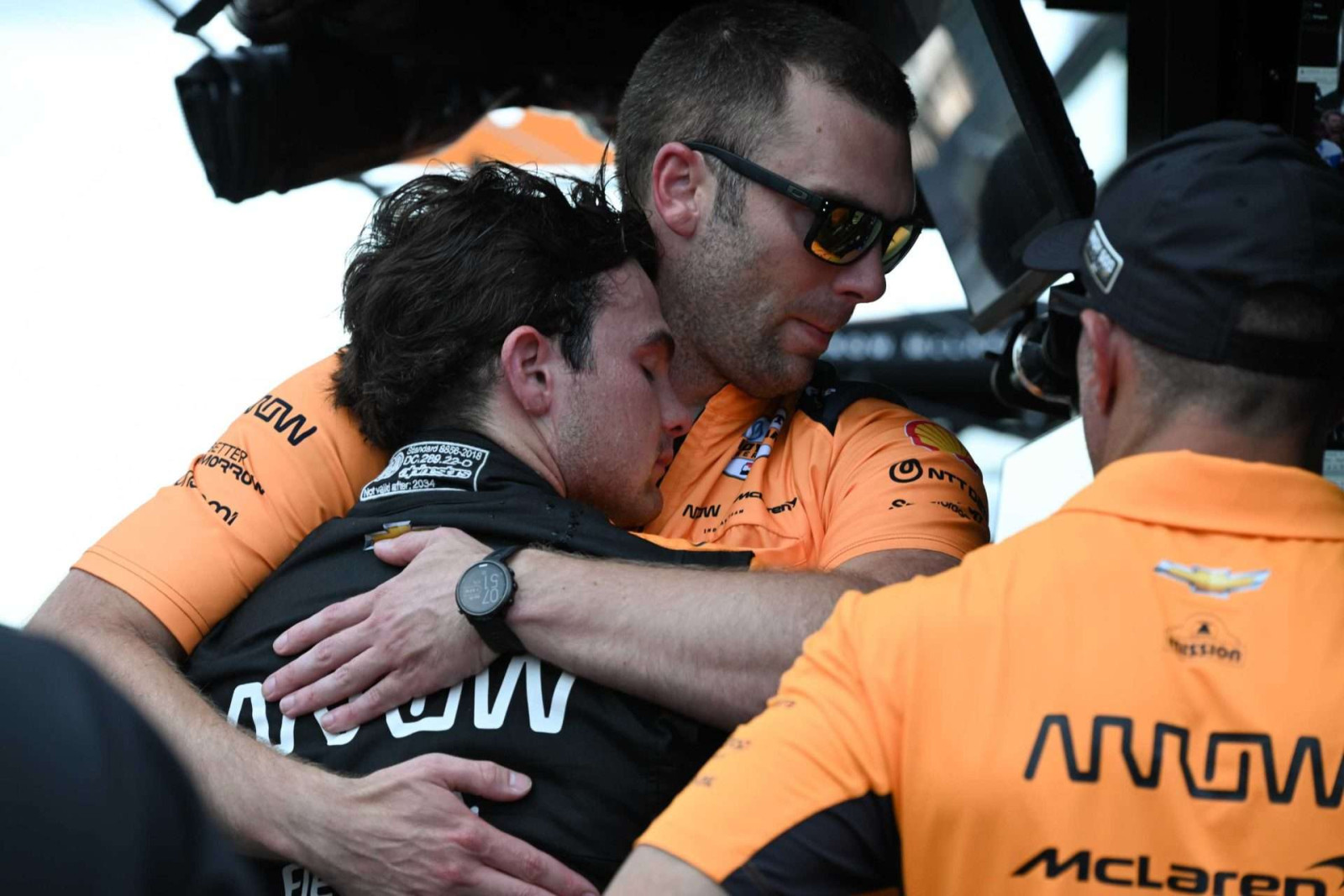
“It’s hard to put it into words,” said a devastated and inconsolable O’Ward, driving for Arrow McLaren. “I’m proud of the work we did today. We recovered from falling back. Some people were just driving like maniacs. We had so many near race-enders. I put my car through so many things I never thought it could do. I risked so much today to put myself in position to win this race. We were so close … again. It’s so painful when you put so much into it and come out two corners short. It’s just heartbreaking. Indy owes me nothing. You just don’t know how many opportunities you will get to win one.”
Scott Dixon, who started 21st, also led four times for 12 laps as the highest finishing Honda powered driver in third.

“It was like a win,” explained Dixon. “We had some ups and downs. Some of the restarts we felt people were jumping (the Green Flag). It was a wild race. Everyone treated each other pretty well and gave each other room. Once they started going back and forth (Newgarden and O’Ward), I was just trying to keep up with their tow. We just didn’t have the speed today. In third place you hope the two in front will crash into each other.”
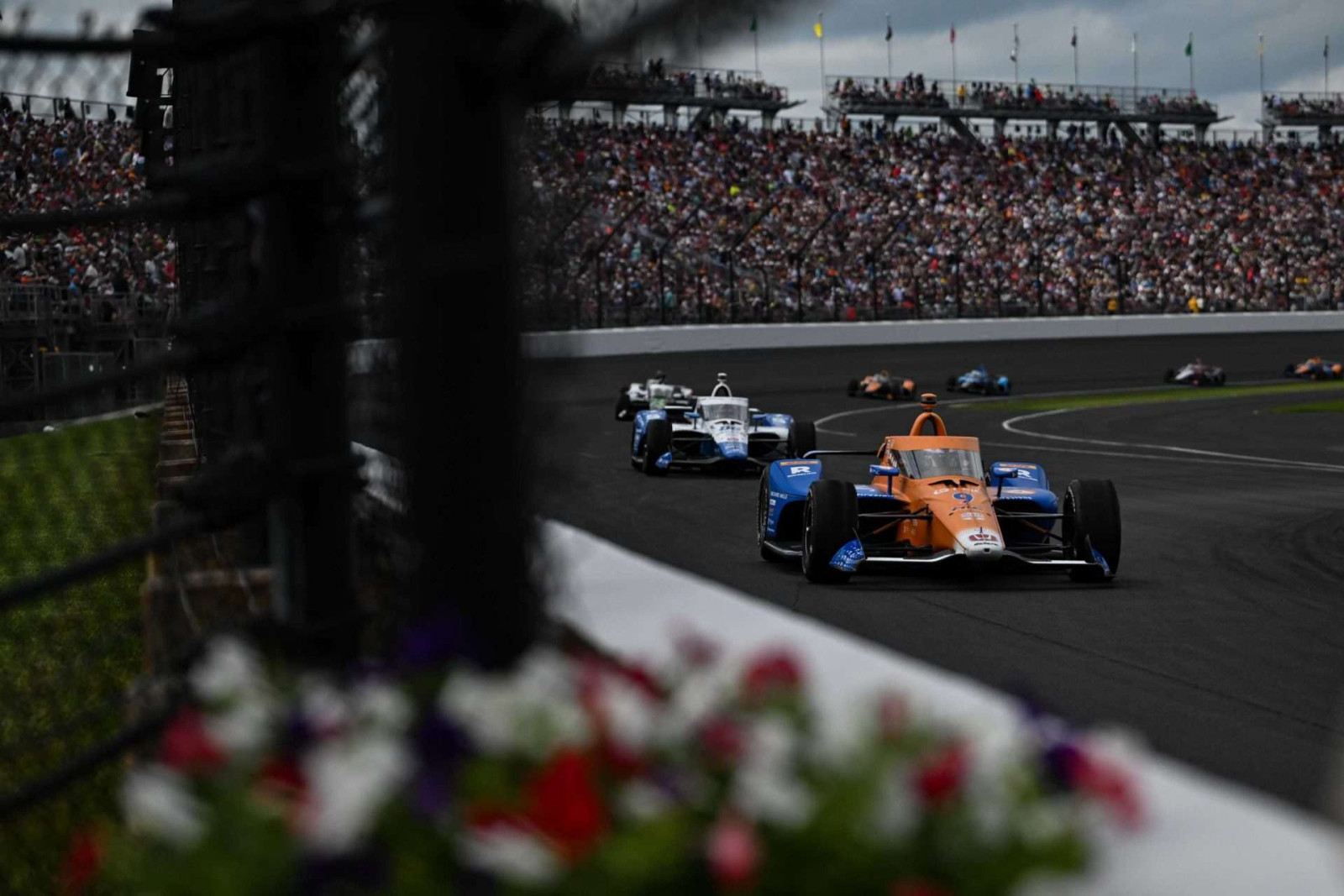
Kyle Larson, driving a one-off entry for Arrow McLaren, started fifth but finished 18th, due to a drive-through penalty for speeding (60 mph speed limit) in pit lane on Lap 134. He was voted Indianapolis 500 Rookie of the Year, worth US $50,000, having ran in the top ten for most of the race until the penalty. The Californian was awarded a total of $178,000.
After spending so much time and preparation for the challenge of the Indianapolis 500, the decision was made to allow Larson to compete, even though the rain delay start time was when he needed to be on his flight to Charlotte. Justin Allgaier started the #5 Hendrick Motorsports Chevy at the NASCAR Coca-Cola 600 (finished 13th) and Larson flew the 400 miles from Indianapolis to Charlotte after the 500’s checkered flag.

The last time a driver attempted ‘the double,’ competing at the Indianapolis 500 and the Coca-Cola 600 in the same day, was when Kurt Busch competed in 2014. Other drivers who have done “the double” include Robby Gordon, Tony Stewart, and John Andretti.
At 10:25 AM, Larson posted on Instagram: “Biggest race of my life today. To be one of a few people to attempt 1,100 miles is really special. A big thank you to @teamhendrick, @arrowmclaren and @hendrickcars for a once in a lifetime opportunity.”
Upon finishing his first Indy 500, Larson said, “I would definitely love to be back next year. I feel like I learned a lot throughout the race. I made a couple mistakes early there with the restarts. Not sure what I did wrong but somehow got myself into third. Definitely feel good about knowing what I would need different for the balance when I come back.”
The fans certainly got their money’s worth from the intense and aggressive driving that went from beginning to end, as though the drivers thought there were only a few laps to go. Cars were often three wide down the long straights, trying to advance in spite of the turbulence from the drivers ahead.
Unlike their struggle for speed in recent years, Team Penske filled the front row with Scott McLaughlin on the Pole, Will Power in the middle, and Josef Newgarden starting on the outside. 1988 was the last time there was a Penske front row. And, although Chip Ganassi Racing was the class of the field the previous few years, their highest qualifier was Alex Palou, starting 14th, missing the Fast 12 qualifying group.
When the race finally started, rookie Tom Blomqvist (gridded 25th in the field of 33 cars), lost control entering Turn 1 (the first turn of 200 laps). The Englishman collected Marcus Ericsson and Pietro Fittipaldi. The race resumed on Lap 10. Then, Katherine Legge, the only woman in the field, retired on Lap 22 with an engine issue. McLaughlin led the first 23 laps but faded with a clutch issue during the race.
Rookie Linus Lundqvist spun in Turn 1 to bring out the third caution on Lap 28. On Lap 56, Felix Rosenqvist had an engine issue that brought out the next caution period. Another caution came out on Lap 86 for Colton Herta, who spun in Turn 1 with minor damage. The Andretti Global driver resumed his race after repairs, 30 laps down.
Ryan Hunter-Ray attempted a late inside pass entering Turn 3 and made contact with Scott Dixon’s left rear tire, causing Hunter-Reay to spin on the infield grass, ending his race on Lap 107. On Lap 114, Marco Andretti spun in Turn 1 with minor damage, bringing out the 7th caution. And the last Yellow occurred when Will Power’s ill handling car made contact in Turn 2 on Lap147.
The lead changed 53 times with 649 on track passes during the 2 hour and 59-minute race that had an average speed of 167.763 mph, due to a total of 46 caution laps. The field was extremely competitive as all 33 qualified cars were within 4.2 mph of each other. Chevy powered drivers filled nine of the fastest 12 cars in qualifying, showing they made significant performance gains over the winter.
The total purse was a record US $18,456,000 (up $1.435 M from 2023), with the winner, Newgarden, earning $4,288,000. By winning back-to-back races, Borg Warner’s $440,000 bonus was included, which increases $20,000 a year until the next double winner. Helio Castroneves was the last back-to-back winner in 2001 and 2002.
Second place O’Ward received $1,050,500 and third place Dixon received $835,000. In last place, Ericsson earned $507,500 as a member of the Leader Circle program and Ryan Hunter-Reay in 26th place earned $102,000 as a non-Leader Circle entrant.
After such a thrilling and epic race, there’s no doubt fans are already renewing their tickets for the 2025 “Greatest Spectacle in Racing.”