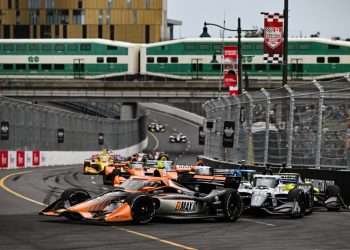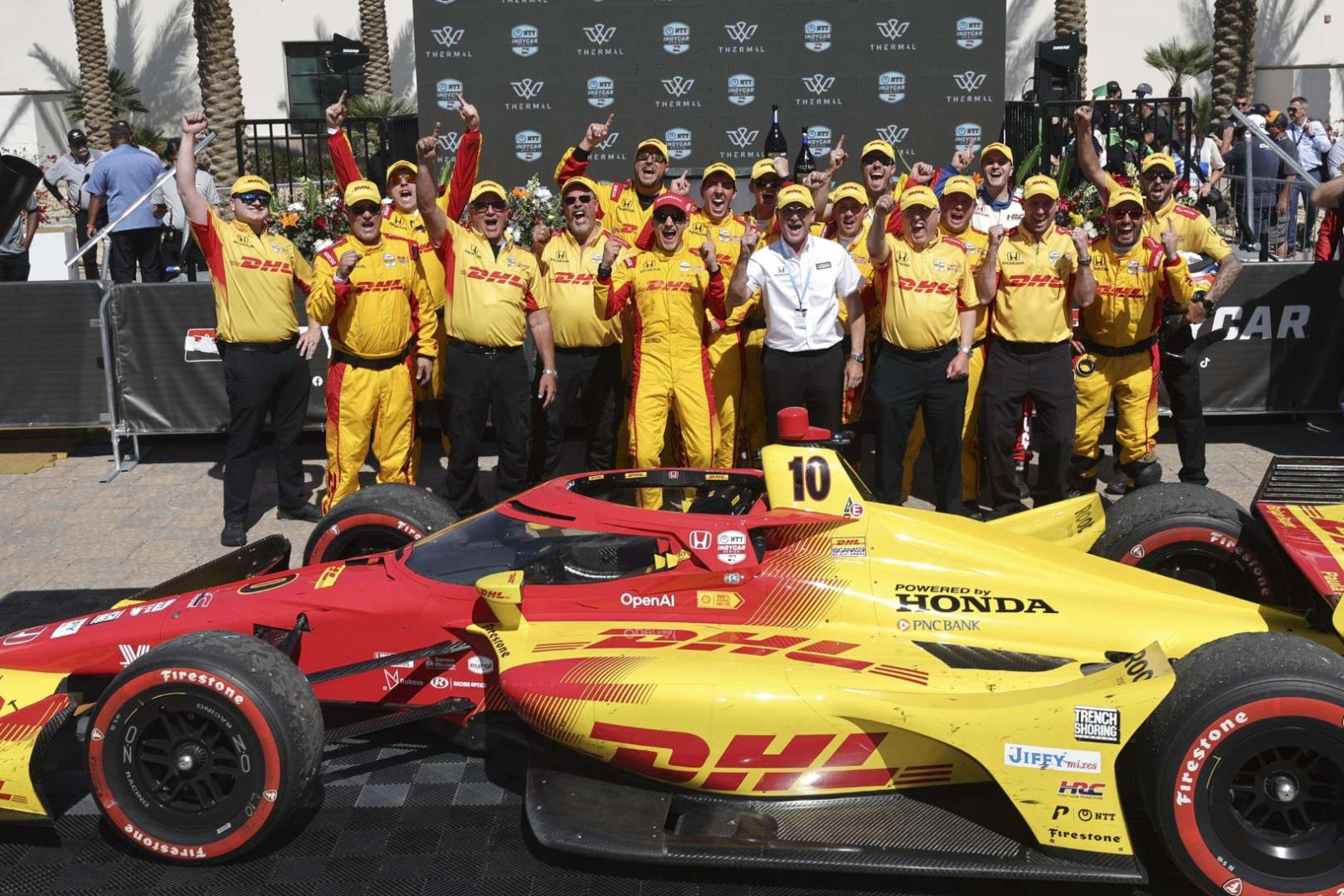
Following an exhibition race at the Thermal Club last year, the NTT INDYCAR Series returned to the track, located 150 miles east of Los Angeles, for a points-paying event in the California desert. The Arrow McLaren team of Pato O’Ward and Christian Lundgaard locked up the front row for the race, but it was Ganassi driver Alex Palou who chased down both McLarens for a thrilling finish, after starting third.
“You always go through a weekend wanting to win, never expecting to win, but maybe expecting to fight,” said Palou, the three-time INDYCAR champion, who bowed out of his contract to drive for McLaren twice in recent years to remain at Ganassi. “There’s so much stuff that needs to go right in order to win an INDYCAR race – all the pit stops, your tire mileage, also fuel mileage. It’s tough to get it all right. It’s amazing to start with a double win this season.
“During the third stint, we were on the same tires – on the primaries (blacks), and I couldn’t overtake Lundgaard”, continued Palou, who leads O’Ward by 39 points in the title fight after race two of 17. “He had really good exits and was doing a great job defending. My car in dirty air was not bad but the temperature on my rear tires just kept going up and up when I was behind him. If you didn’t get a pass done in your first try, you were probably going to stay behind the car in front. It was tough to pace. But I did it when I had the tire advantage on the new alternates (reds), when both O’Ward and Lundgaard were on primaries (blacks for the final stint).”
Once on the new alternate (softer) tires from his final pit stop, Palou wasted no time chasing down Lundgaard, who was about ten car lengths ahead. Palou traded places back-and-forth with Lundgaard for second-place through four consecutive turns, on Lap 51 of the 65-lap race, that surprisingly had no cautions.

The Spaniard then chased down O’Ward, who was eleven seconds ahead, in just five laps. The right call on the number of pit stops and preferred tires determined the outcome.
“I knew I was going to catch him, for sure,” said Palou. “But I didn’t know if I was going to be able to pass him once I caught him. It just depended on the tires. I had to be a little bit patient at the beginning. The question was if I was going to be able to overtake him and then pull away.”


O’Ward, who started the race on sticker alternates before using three sets of new primaries, was at a disadvantage to Palou, who started on used alternates, ran two sets of new primaries, and ran his new alternates in the final stint.
“We need to keep pushing,” stated a very disappointed O’Ward, who led 51 laps. “We obviously weren’t perfect. The team did a phenomenal job in the pits. The car has been a joy to drive all weekend. We ran a red, black, black, black (tire) race. It should have been a red, red, black, black or any sort of combination with two reds and two blacks.
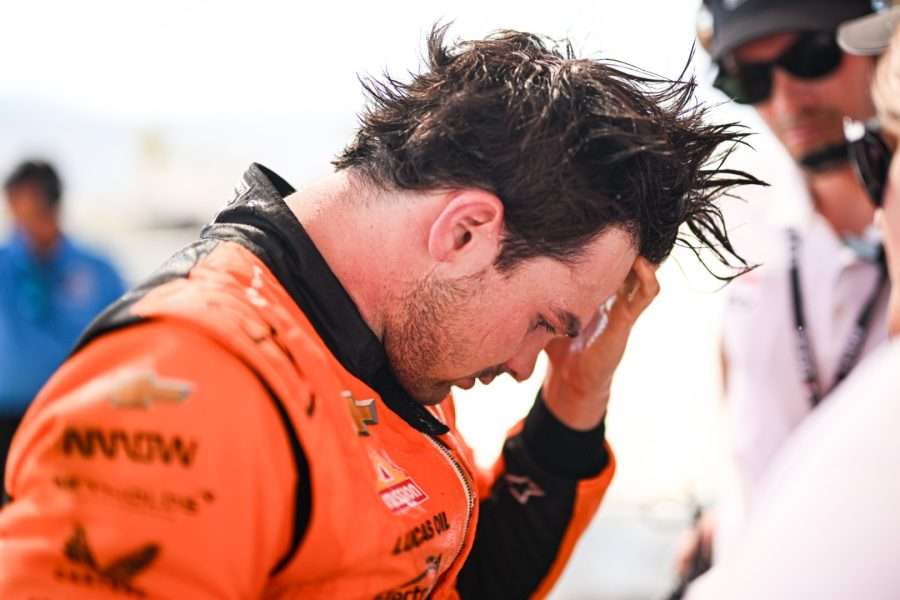
“It sucks to be the leader,” continued O’Ward. “All of our Chevy affiliate teams are worthless with helping when a Chevy leader is coming up on them. Honda seems to work as a team very, very well because (Louis) Foster was doing everything in his power to keep me behind. Palou gets right behind him, and he just lets him cruise by.”
Most drivers made three pit stops, utilizing four sets of tires. By rule, each driver must run two laps on both the primaries and new alternate tires. No one knew what the best strategy would be on the abrasive track surface because not enough laps were run to determine where the fall off in grip would be, especially due to the 40°F / 19°C increase in temperature between morning practice and qualifying/race conditions (as high as 88°F / 31°C ambient and a track temperature over 120°F / 49°C).
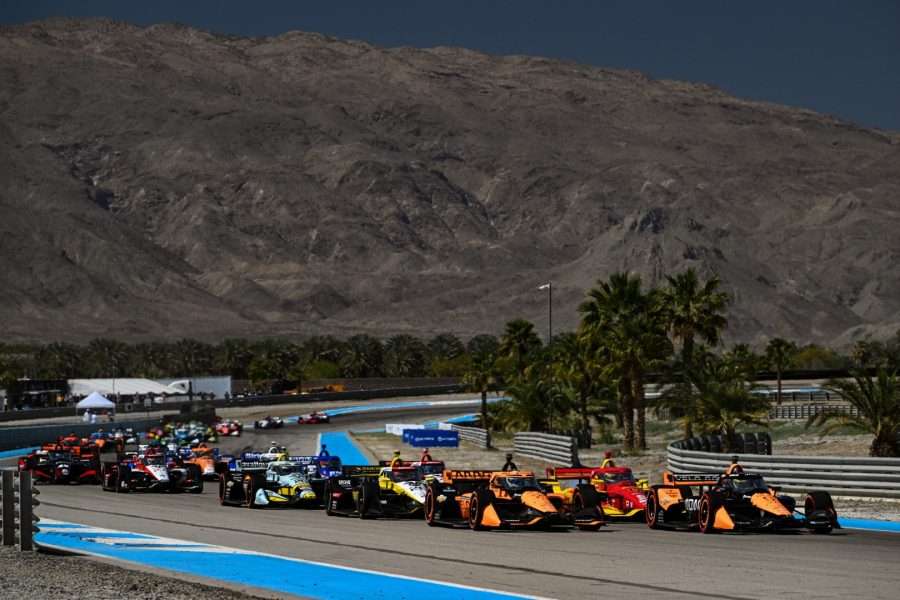
Even with the expected tire degradation on the 3.067-mile, 17-turn track, some drivers felt that the alternates would be the best choice. Since drivers are only allocated four sets of alternates for the weekend (first set for practice and returned, second and possibly the third set used to advance in knock-out qualifying, fourth set mandatory in the race), they may have to run used alternates (from qualifying) for a shorter distance.
“There wasn’t a single team that knew what the strategy was going to be today,” said Barry Wanser, Ganassi Senior Manager of Racing Operations and Race Strategist for Palou. “It was pure luck how the race was going to play out.”
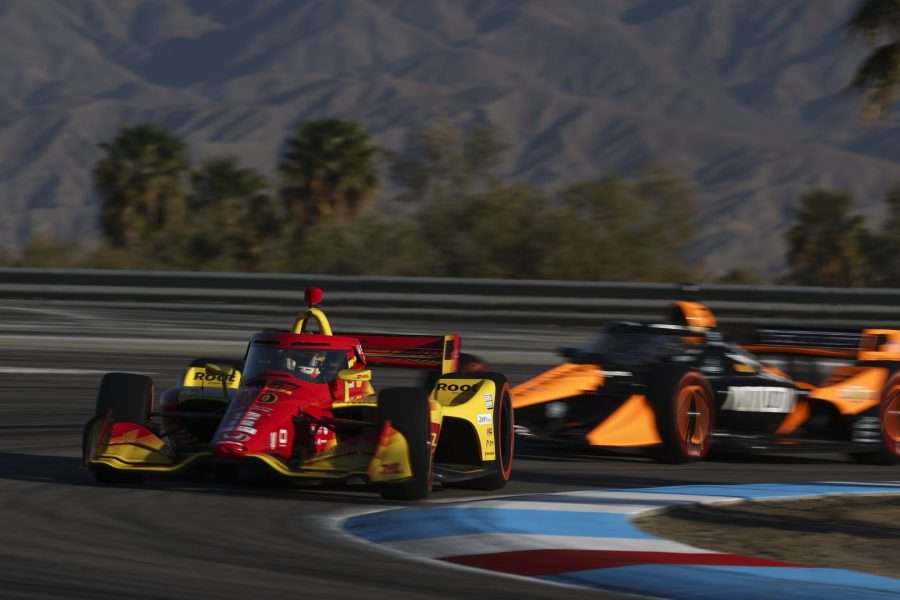
Toronto’s Devlin DeFrancesco ran his first race at Thermal, having only tested there with the Andretti Global team in 2023. He qualified 26th but had contact before the green flag, finishing 20th, in spite of a drive-through penalty.
“I got hit before the green flag even started,” revealed DeFrancesco, driving for Rahal Letterman Lanigan Racing. “(Scott) McLaughlin closed the line as we were supposed to be running side-by-side through Turn 15. He left me no room and turned down on me, which caused us to have a drive-through (penalty). So not only did we start last, we started 30 seconds behind everybody else.
“The No. 30 Mi-Jack Honda was strong, especially on alternate tires,” he continued. “We seemed to really be able to carve our way through. That last stint on primary tires, we just bottomed on the out lap. Where I would have started, we would have probably been around 14th, considering the drive-through. We need to go review it with the INDYCAR stewards because, in my opinion, that drive-through was uncalled for.”
Uncharacteristically, Team Penske drivers showed poorly in qualifying, with Josef Newgarden starting 17th, Will Power starting 21st, and McLaughlin starting 25th. Power managed a sixth-place finish and Newgarden finished 13th. McLaughlin was 27th after the contact with DeFrancesco.
The Thermal Club, comprised of 426 acres, which includes over five miles of track, offers residential lots for residents to build custom homes, where they can drive their high-performance cars on the twin palm-shaped permanent road course. Recently, F1 champion Max Verstappen purchased a US $7 million villa there. The track is located near Palm Springs, in the Coachella Valley.